This article was originally published on Signal Leading, where I write about building B2B sales intelligence in public.
The Revenue Team BUT Least Served by AI
Sales is the team that generates revenue. It's also the team stuck doing the most repeated, manual work to earn it — updating CRM fields, chasing status changes, re-typing notes after every call.
550 hours, $32,000 per rep, per year — wasted on bad CRM data.
Outdated and duplicate CRM data costs each sales rep an estimated 550 hours and $32,000 per year — time that should go to conversations, not data hygiene. (Source: CRM Productivity Study)
Every other department — support, marketing, finance — has been handed AI copilots built specifically for their workflow. Sales, the team actually bringing in the revenue, is still the least served.
Today's Solutions Cater ONLY part of the Sales Cycle
There are solutions out there — 6sense, Demandbase, ZoomInfo, Clay, and others. But most of them focus on lead qualification only. Some merely generate a robotic, generic door-opener that reads the same for every prospect.
More importantly:
Qualification is only the FIRST part of selling.
What happens after qualification?
If you're interested, check out my Silence Trap series for enterprise sales:
- Clients have too many options
- Clients fear starting a project
- Clients fear overpaying
- (Coming soon)
- (Coming soon)
Right now, almost NO solution addresses this: detecting silence, and strategizing how to break silence traps.
Sure, you can always describe your situation to an AI agent and get plenty of suggestions. But you have to feed it everything manually. It's a separate solution from whatever your company already runs — one more scattered tool to manage.
MORE Tools Make Even "less" selling
957 applications, only 27% integrated
The average enterprise now runs 957 applications, but only 27% are connected — every disconnected app is a silo where intelligence goes in but never flows out. (Source: MuleSoft 2026 Connectivity Benchmark Report)
This fragmentation doesn't just slow sellers down — it costs them the deal.
45% less likely to hit quota when overwhelmed by tools
Sellers using an average of 8 disconnected tools are 45% less likely to hit quota — not for lack of effort, but because fragmented tooling creates friction that compounds across every deal. (Source: Gartner Sales Survey 2025)
We have plenty of AI tools! However, without a real integration, they become a hurdle, not a help.
Where We Already Play
I said most B2B sales solutions stop at qualification — frankly we, Signal Leading, also covers that too:
The difference: ours isn't a standalone tool. Every lead gets classified into one of four categories:
- 🟢 DIRECT — act now, clear buying moment
- 🟡 VERIFY — explore fit collaboratively
- 🟣 CULTIVATE — plant a seed, no pressure
- 🔵 NURTURE — right ICP, wrong moment, stay warm
Note: unqualified leads or ⚫ Not Applicable are filtered out early — they never make it past ICP fit.
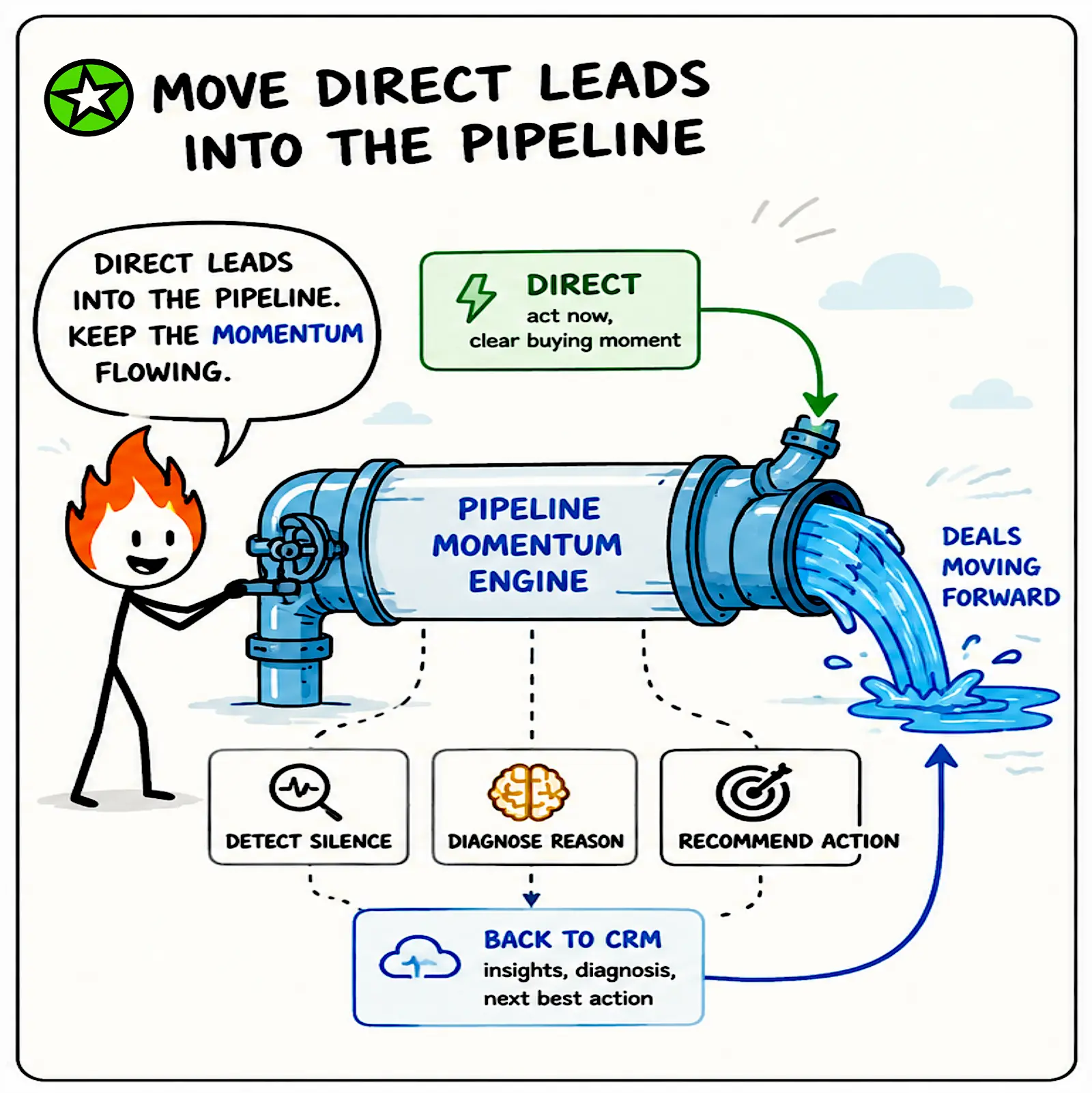
DIRECT leads move into the pipeline, where door-openers and talking points are tailored to the client's real signals, not a generic tone padded out with "your business is growing" filler. (Details: Outreach Prep by AI)
The door-opener is built around the client's actual signals, not the generic, one-size-fits-all tone most tools default to.
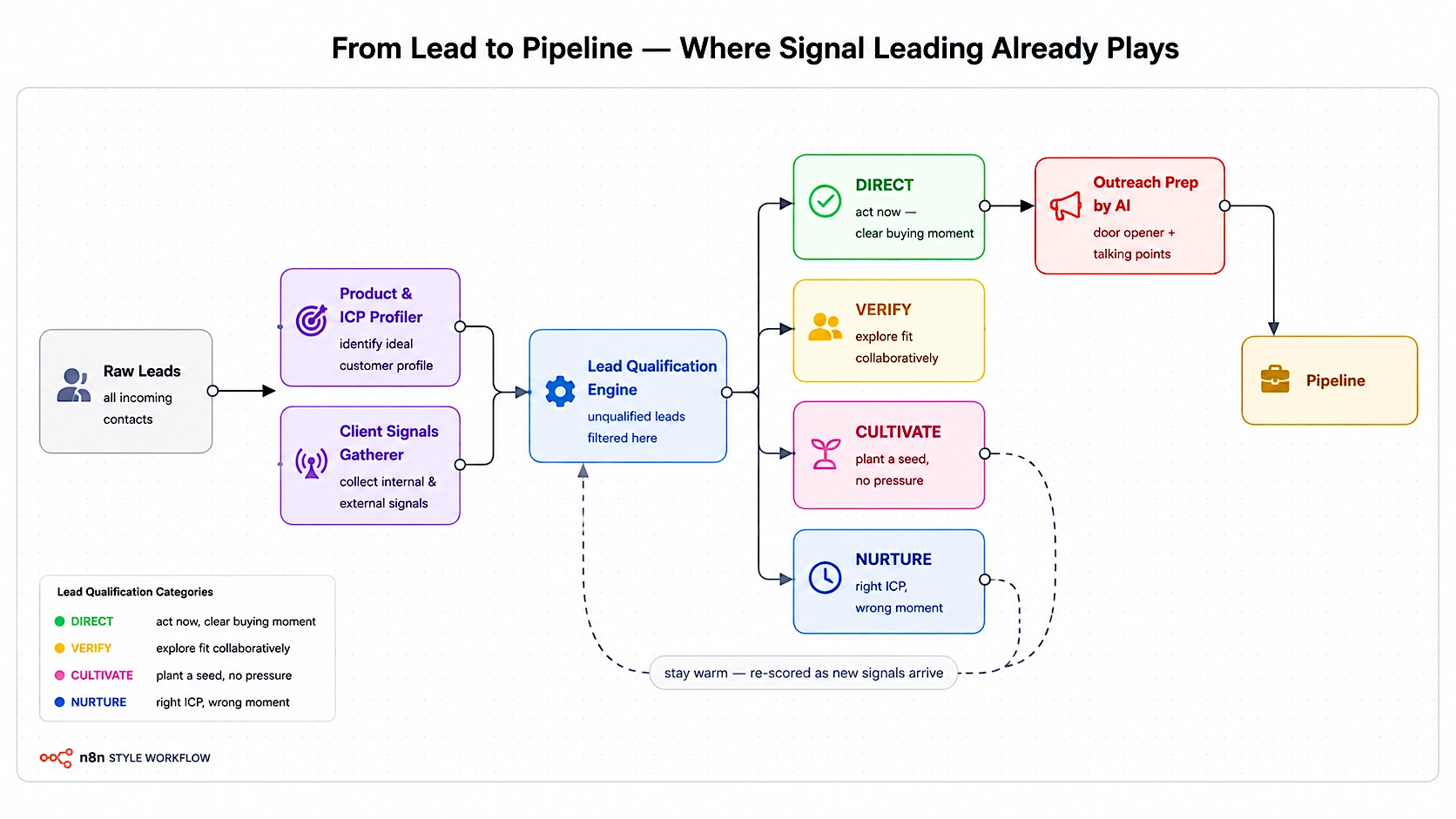
From lead to pipeline — where Signal Leading already plays.
What We'll Build — Pipeline Momentum Engine
Following the Lead Qualification Engine and Outreach Door Opener Engine, we're building the Pipeline Momentum Engine — focused on pushing deals past the point they stall, once they're already in motion.
What It Does
The Pipeline Momentum Engine collects signals from your CRM, meetings, emails, documents, and external company events. It then detects patterns, diagnoses why an opportunity has gone quiet, recommends the next best action, and writes the intelligence back into your CRM.
The goal isn't another dashboard. It's an intelligence layer that helps sales teams understand what the signals are really saying.
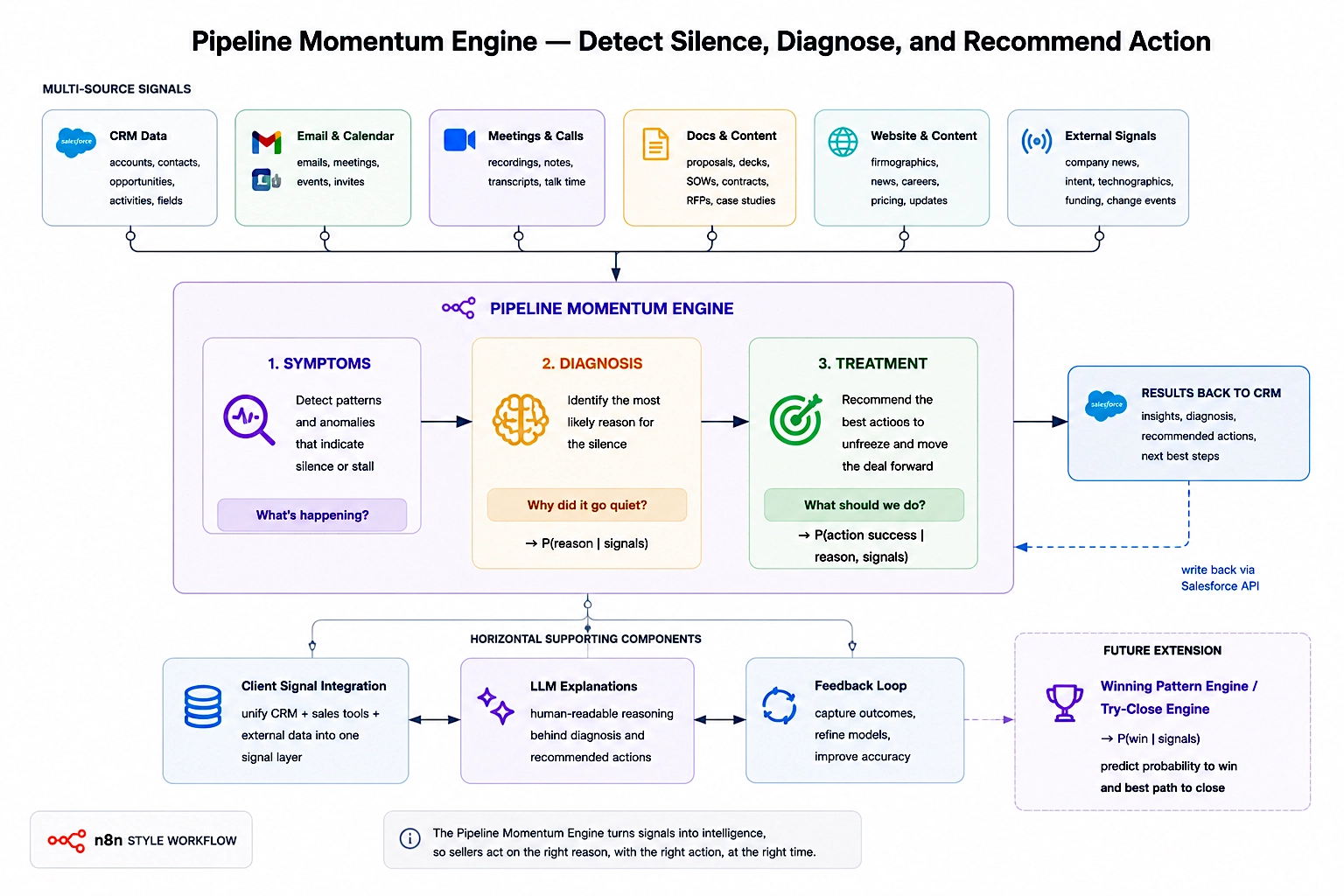
Turning signals into intelligence: detect silence, diagnose the reason, recommend action, and feed the result back into the CRM.
The engine doesn't replace the CRM. It makes the CRM smarter by turning disconnected signals into diagnosis and action.
How It's Built
We are going to share more details in the coming week. In brief, we'll:
Step 0 — Setup:
CRM, sales-tool, and AI sandboxes. Establish integrations and identify which signals can realistically be collected from each system.
Step 1 — Silence Signal Engine
Estimating the probability of each silence trap from gathered signals
→ P(reason | signals)
- Start with a rules engine detecting the 5 silence traps
- Build a feedback loop to capture outcomes
- Enrich the dataset with new observations and signals
- Gradually introduce machine learning models to improve accuracy
Keep the diagnosis sharp over time.
Step 2 — Silence Tackling Engine
Recommending the next best action for each silence trap
→ P(action success | reason, signals)
- Sales Playbook RAG built
- Strategize the right response for each silence trap
- Explain why the recommendation was made
The diagnosis is only useful if it comes with a next move.
Supporting components:
- Client signal integration across CRM, sales tools, and external sources
- LLM explanation layer for human-readable reasoning
- Feedback loop to continuously improve diagnosis accuracy
Longer term, we also want to explore:
→ P(win | signals)
Can we identify winning patterns and recommend the best path to close before the opportunity is lost?
What This Actually Benefits You
Why a Pipeline Momentum Engine
Facilitating Sales Reps is our only Mission.
- Sales stops working in silos — the system learns your team's common patterns to reduce repeat silence traps
- Every tool and every CRM field works together for one intelligence layer — your AI co-pilot acts on real signal, internal and external, instead of guesswork
- Time that used to go into CRM hygiene and guesswork on stalled deals goes back into actual selling
In the coming weeks, I'll keep sharing the Sales Silence series — and share the design, architecture, and experience as I build this.

![[8-Day Closmore SaaS Challenge] - NO Coding in Day 1](/media/postuploads/day-1-saas-mvp-architecture-closmore.jpg)
![[8-Day Closmore SaaS Challenge] Day 5-6 — "What If...?"](/media/postuploads/error-handling-code-for-Closmore-SaaS-Day-5-6-What-if-audit-1.jpg)
![[8-Day Closmore SaaS Challenge] Day 8 — Commercially Real — License & Billing](/media/postuploads/Closmore-licence-commerically-real.jpg)